
Many businesses invest in SEO because they want higher Google rankings. But rankings alone are not the real objective.
The real goal is to attract the right people to your website and turn those visitors into leads, customers, and sales.
A website can rank for hundreds of keywords and still generate very few customers if it targets the wrong searches, provides a poor user experience, or fails to give visitors a clear reason to take action.
A successful SEO strategy connects search visibility with business goals.
In this guide, we’ll explain how businesses can build an SEO strategy designed not only to increase organic traffic but also to generate measurable business results.
1. Start With Your Business Goals
Before choosing keywords or publishing content, determine what you actually want SEO to achieve.
Your goal might be:
- More website leads
- More phone calls
- More product sales
- More consultation requests
- More local customers
- More online bookings
- Greater brand visibility
Your SEO strategy should be built around these objectives.
For example, an online store may focus on product and category searches, while a service business may focus on commercial keywords such as “SEO agency,” “web design services,” or “PPC marketing agency.”
The best SEO strategy is therefore not simply about getting more traffic. It is about getting relevant traffic.
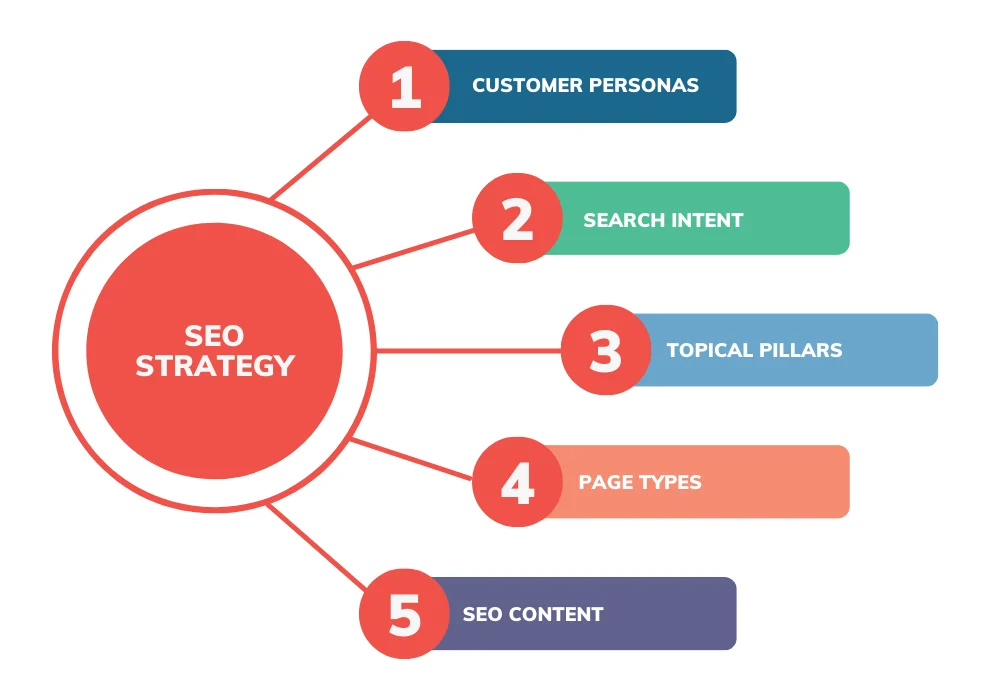
2. Target Keywords Based on Search Intent
Search intent describes what a person is trying to accomplish when they search Google.
Consider these three searches:
“What is SEO?”
The user is looking for information.
“How much does SEO cost?”
The user may be researching a potential purchase.
“SEO agency for small business”
The user is much closer to contacting a service provider.
These searches represent different stages of the customer journey.
Your website should contain content for each relevant stage.
Informational Keywords
These are useful for blog posts and educational content.
Examples:
- What is technical SEO?
- How do backlinks work?
- What is local SEO?
Commercial Keywords
These are useful for comparison and service pages.
Examples:
- Best SEO agency
- SEO services for small businesses
- Website design services
- Digital marketing company
Transactional Keywords
These can indicate stronger purchase intent.
Examples:
- Hire SEO agency
- Buy SEO services
- PPC management services
- Professional web design
Understanding intent allows you to create the right page for the right search.
3. Build Pages Around Your Most Valuable Services
If your company provides multiple services, don’t force every service onto one page.
Create clear pages that explain each major service.
For example:
SEO Services
Explain your SEO process, technical optimization, content strategy, keyword research, and reporting.
Web Design
Explain your design process, mobile optimization, user experience, website performance, and conversion strategy.
PPC Advertising
Explain campaign setup, keyword research, advertising strategy, landing pages, and performance tracking.
Backlink Services
Explain your approach to link building, relevance, quality, and outreach.
This structure makes your website easier for customers to navigate and gives search engines clearer information about the topics your business covers.
You can naturally connect these pages to your main website at SEO Marketing House.
4. Create Content That Supports Your Services
A strong SEO blog should not exist separately from your business.
Your content should support your most important services.
For example, if you provide SEO services, useful articles could include:
- How Long Does SEO Take?
- How Much Does SEO Cost?
- How to Perform an SEO Audit
- How to Improve Google Rankings
- What Makes a Good Backlink?
- Why Is My Website Not Ranking?
- How Does Local SEO Work?
Each article can naturally introduce a related service.
For example, an article explaining technical SEO could link to your SEO service page. An article about website speed could link to your web design service.
This creates a logical connection between informational content and commercial pages.
5. Use Internal Links Strategically
Internal linking is one of the easiest ways to improve your website structure.
Instead of randomly adding links, connect pages that are genuinely related.
For example:
SEO article → SEO services
Backlink article → backlink services
Website speed article → web design services
PPC guide → PPC services
Use descriptive anchor text that tells visitors what they will find after clicking.
Google’s current documentation emphasizes descriptive and useful links because links help users and search engines discover relevant pages.
6. Build Authority With High-Quality Content and Links
Competition is often high for commercial keywords.
Publishing useful content can help your website demonstrate expertise, while relevant backlinks can help people discover your content and strengthen your site’s overall authority.
Potential link-building strategies include:
- Digital PR
- Industry publications
- Relevant directories
- Guest contributions
- Business partnerships
- Original research
- Statistics and studies
- Useful resources
However, avoid building links purely to manipulate rankings.
Google’s current spam policies specifically identify link spam and keyword stuffing as practices that can violate its guidelines.
The objective should be to create something useful enough that another relevant website has a genuine reason to reference it.
7. Make Your Website Convert Visitors
SEO can bring people to your website, but your website must persuade them to take action.
Imagine that 1,000 people visit your website every month.
If nobody contacts you, requests a quote, books a consultation, or makes a purchase, increasing traffic alone won’t solve the problem.
Review your:
- Headlines
- Service descriptions
- Contact forms
- Calls to action
- Testimonials
- Portfolio
- Pricing information
- Trust signals
- Mobile experience
Every important page should make the next step obvious.
For example:
Need More Customers From Google?
Request Your SEO Consultation
A simple and relevant call to action can make the customer journey much clearer.
8. Don’t Ignore Technical SEO
Technical problems can prevent search engines from properly accessing or understanding your website.
Important areas include:
- Indexing
- Crawling
- XML sitemap
- Robots.txt
- Canonical URLs
- Mobile usability
- Page speed
- HTTPS
- Structured data
- Broken links
- Duplicate content
Google provides documentation covering technical requirements and how Search works, making it a useful reference when diagnosing SEO problems.
You can also use Google Search Console to monitor indexing and search performance.
9. Use Search Console to Find Opportunities
Google Search Console can show you how your website performs in Google Search.
You can use it to identify:
- Search queries
- Impressions
- Clicks
- Average position
- Indexing issues
- Search performance
- Pages receiving organic traffic
One particularly useful strategy is finding pages that receive many impressions but relatively few clicks.
You can then test improvements to the page title and content to make the result more relevant and attractive to searchers.
Google continues to recommend Search Console as a way for site owners to understand search performance and indexing.
10. Optimize Existing Content
SEO isn’t only about publishing new articles.
Your existing pages may already have potential.
Look through older content and ask:
- Is the information still accurate?
- Does the page fully answer the searcher’s question?
- Can the introduction be improved?
- Are there missing sections?
- Can relevant internal links be added?
- Is the title clear?
- Is the call to action strong?
- Can outdated information be removed?
Regularly improving valuable content can help keep your website useful as search behavior and competition change.
11. Combine SEO With PPC
SEO and PPC can work together.
SEO is generally a long-term strategy for building organic visibility, while PPC can provide paid visibility for selected searches.
For example, a business launching a new service could use PPC to generate immediate visibility while simultaneously building an organic SEO strategy around the same service.
The data from paid campaigns can also help businesses understand which offers and search terms attract potential customers.
12. Track Business Results
Don’t measure your SEO campaign only by rankings.
Track metrics that connect SEO with business performance:
- Organic traffic
- Qualified leads
- Contact form submissions
- Phone calls
- Consultation requests
- Sales
- Conversion rate
- Revenue
A ranking improvement is useful, but a ranking that generates no business value should not be your only success metric.
The most important question is:
Is SEO helping the business grow?
13. Think Long-Term
SEO is not a one-week project.
A strong strategy requires continuous improvement:
Research → Create → Optimize → Publish → Promote → Measure → Improve
Over time, your website can build a larger collection of useful content, stronger internal connections, more relevant authority, and better visibility for important searches.
Google’s documentation is also regularly updated; its September 2026 updates include changes and additions around search appearance, regional search experiences, and site reputation guidance.
Final Thoughts
A successful SEO strategy is not about putting as many keywords as possible onto a website.
It is about understanding what potential customers search for, creating useful pages that match their intent, building a logical website structure, earning relevant visibility, and making it easy for visitors to become customers.
For businesses competing online, SEO can become much more than a traffic-generation strategy.
When SEO is connected to content, web design, backlinks, PPC, conversion optimization, and business goals, your website can become a consistent customer acquisition channel.
If you’re looking for professional SEO and digital marketing solutions, visit SEO Marketing House.

Author